{”version”: 3, ”isGlobalStylesUserThemeJSON”: true }
Tekijä: admin
Timekeeping on Mars
Few years back I noticed that new year will start on Mars. I started to think about timekeeping on Mars. How long its year is, how long is a sol (Mars day)? How would one have the months, since Mars doesn’t have a proper moon for such division?
Quickly, I compiled a calendar, since the new year was coming. It was for the Mars year 36. (First Mars year started in 1955 in our calendar.) I wasn’t too happy with the result, the time ran out. So I decided to try again next year, and compiled a calendar for Mars year 37. (Link is directly to the pdf-version of the calendar.)
When that year finished, I made a third one for Mars year 38, which starts on 12.11.2024 Earth time. The calendar shows 18 calendar spreads, divided into seasons and ”quarants”. (There is no official agreement about how to divide Mars’s sols into segments, so I just used groups of 40 sols in four seasons. The last 40 sol segment in each season falls short.)
To make the calendar more interesting, I added pictures from NASA etc. from Martian landscapes and areas with info. There’s also a chart of the inner solar system in each spread showing the positions of earthlike planets around the Sun in the beginning of that ”quarant”.
Still, the bread and butter of the calendar are the presented views of Martian skies in each spread. The calendar shows the most interesting objects in the sky, as if the user would be an amateur astronomer living on Mars. The pictures I drew with the help of Stellarium planetarium programme. The info is hand-picked from the data.

Both calendars, years 37 and 38, turned out nicely, but the amount of work was insane. (I tried not to use too much of the same material in both.) The best part was that planning and working with this really took me into Mars, thinking how it would be like over there.
Next Mars year, 39, is starting on 30th September 2026. I finished the calendar during summer, and it’s downloadable here in Finnish. (The English version is coming soon.)
Lataa suomenkielinen Mars 39 -kalenteri tästä / Lataa suomenkielinen Mars 39 -kalenteri 3mm bleedillä painotaloa varten tästä
The calendar for Mars year 38 is in Finnish and in English, both having a version without bleed for web viewing as well as 3mm bleed for professional printing (output is Coated FOGRA39). I recommend printing the calendar on the wall, so it can be followed throughout the Martian year.
Lataa suomenkielinen Mars 38 -kalenteri tästä / Lataa suomenkielinen Mars 38 -kalenteri 3mm bleedillä painotaloa varten tästä
Download the English version of Mars 38 calendar from here / Download the English version of Mars 38 calendar with 3mm bleed for printing houses from here
This Mars 38 calendar is CC BY-NC-ND 4.0 so feel free to send it to or print it out and give it to anyone you think would be interested in dwelling into Martian life. It might work well also in schools or science clubs to inspire learning more about Mars.
Neighbours of the Solar system
Some time ago, I tried to find a star map of the closest stellar systems to us. The Sun is our star, and many people know that Alpha Centauri is the closest star to us after our own Sun, but what else is there? I couldn’t find a version I liked, so I decided to draw one myself.
It took a few years to finish this project, but in the end it turned out really nice. I drew everything by hand, so it’s not scientifically accurate, but it does give the overall picture about our neighbourhood. The striking number of red dwarves gives perspective to the stars we don’t see – the M-class stars are too faint to be visible with our naked eye, and they make ca. 75% of all the stars in the universe. And all the brown dwarves around us we haven’t even found yet.
The map shows the nearest stars in 30 light-year radius. The bigger the star is, the closer it is.
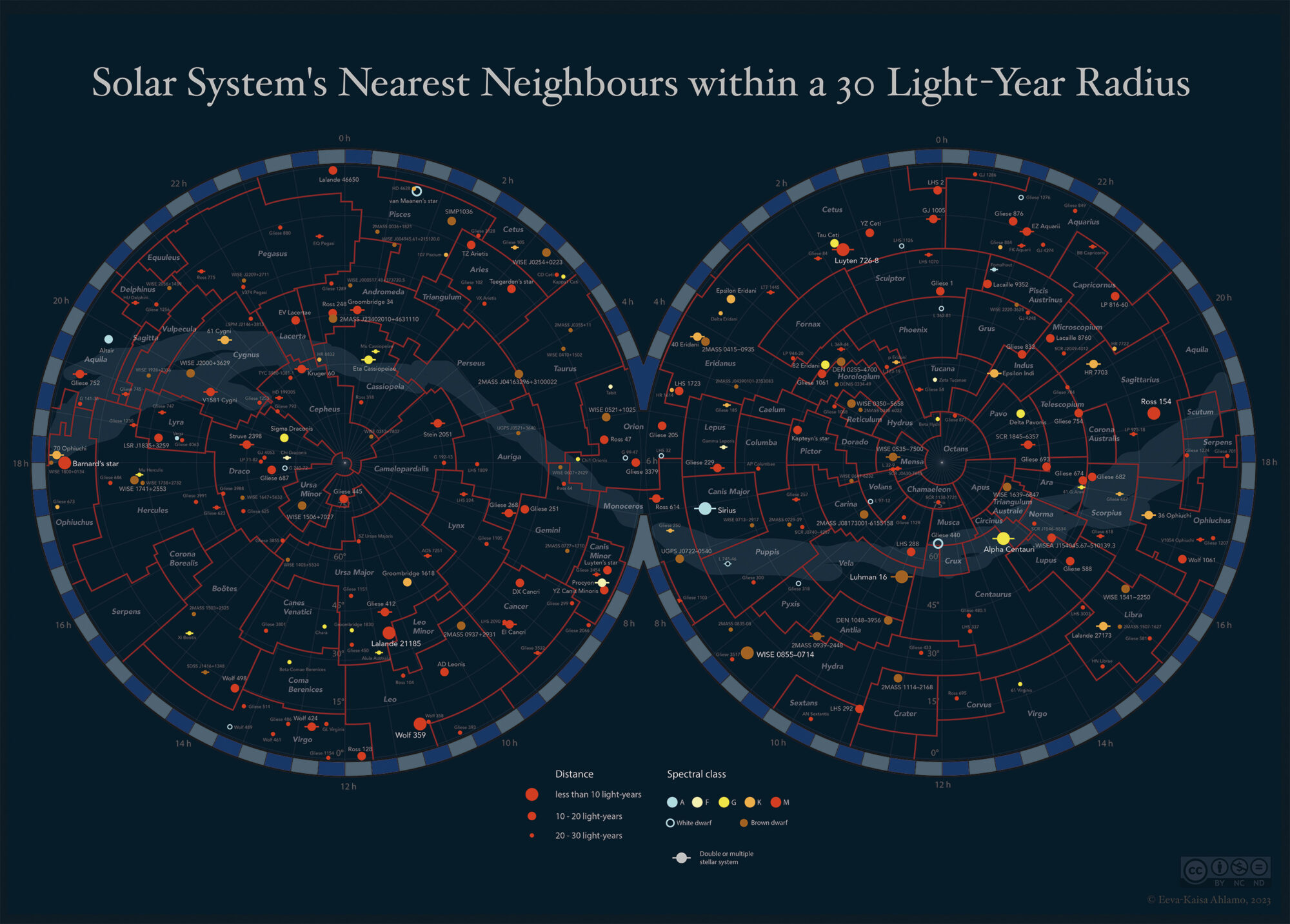
The map is available in English and in Finnish. This design is Creative Commons, CC BY-NC-ND 4.0. You are free to download, print and share it as it is, as long as you won’t do changes and try not to profit from it. (My name is already in the design for the credit.) The file is a printable format, the size is normal poster size in Europe, 70cm x 50cm. There is 3mm bleed on all sides for printing. Format: CMYK Coated FOGRA39. I encourage you to make a print for yourself or your local school!
You can download the English version of the star map from here
You can download the Finnish version of the star map from here
I love astronomy. I’ve been amateur astronomer since I was a kid, and nowadays it more like a lifestyle than a hobby. In my 20s, I moved to New Zealand for a couple of years to see the southern night sky. I’ve done stargazing shows in my local astronomy society since the mid-1990s. I’ve even been awarded the Finnish amateur astronomy award Stella Arcti for ”the significant promotion of amateur astronomy both locally and nationally, as well as commendable work for popularising astronomy”.
For me, standing under the starry sky with my telescope I feel like being one with the universe. I enjoy greatly, when I learn new things about astronomy, physics or natural sciences in general – even if I cannot read mathematics. (I actually have difficulties calculating per cents. I was never a mathematical person.) Looking at stars, observing, reading, exploring, but also explaining, telling stories and inspiring people are all a big part of my astronomy hobby.
You can contact me by sending mail to west468@gmail.com.

I’m a Finnish amateur astronomer, who also likes to do grafical stuff from time to time. Here are some astronomy / natural science related projects I’ve done. I hope you find them inspiring!

Map of the Closest Stars
Neighbours of the Solar system

Mars Calendar
Timekeeping on Mars